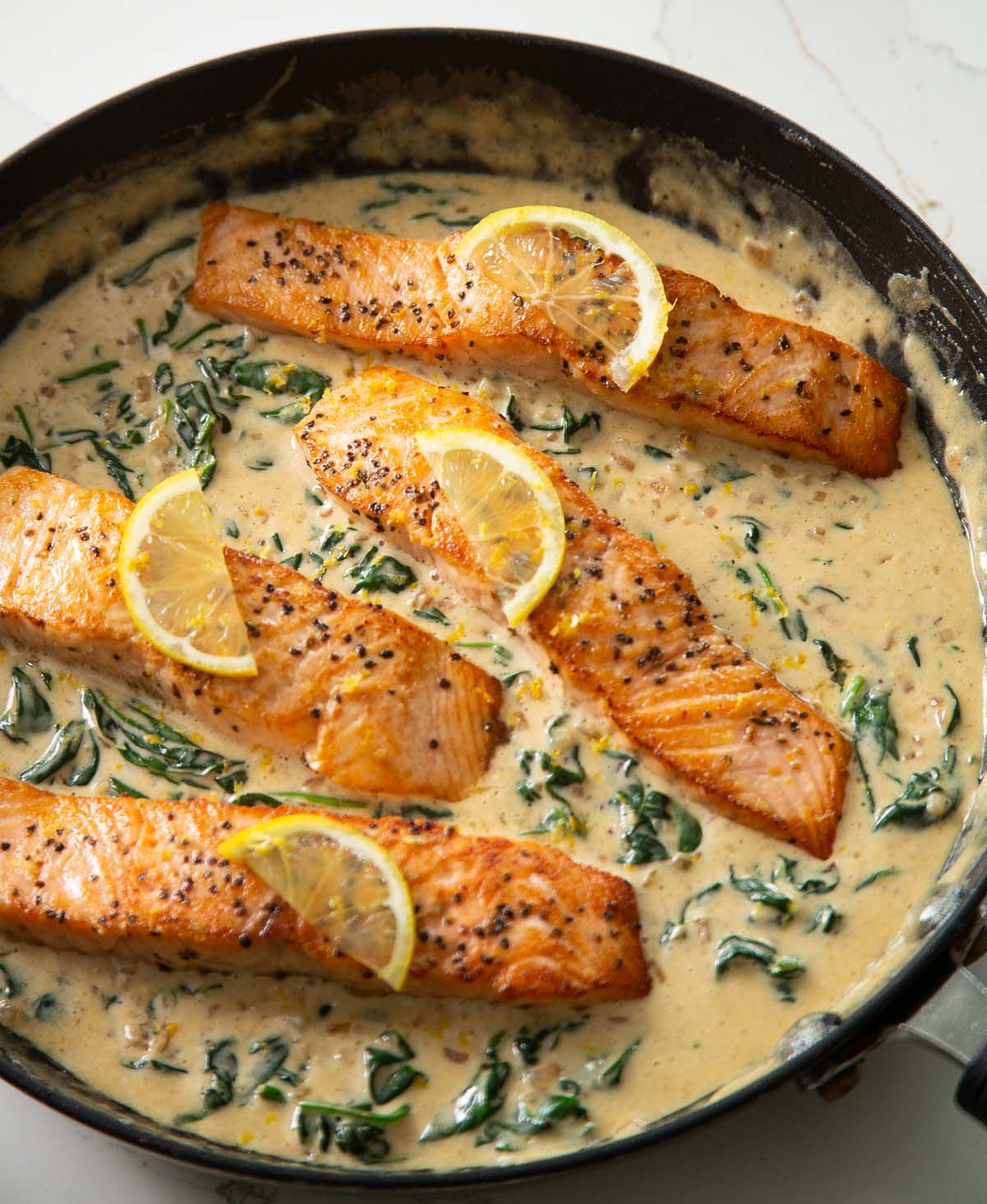
This salmon florentine is elegant, completely delicious and beyond simple to make!
Strap yourself in, because today I’m going to show you how to make restaurant-quality salmon florentine that comes together in 25 minutes and only requires basic ingredients. Follow me…
Salmon and Spinach
‘Florentine’ (or à la Florentine) essentially just means something served on a bed of spinach. A popular variation is chicken, but salmon works just as perfectly. More modern interpretations have used creamy spinach bases, and if you’ve been here before, you know that’s RIGHT up my street.
Cooking the spinach
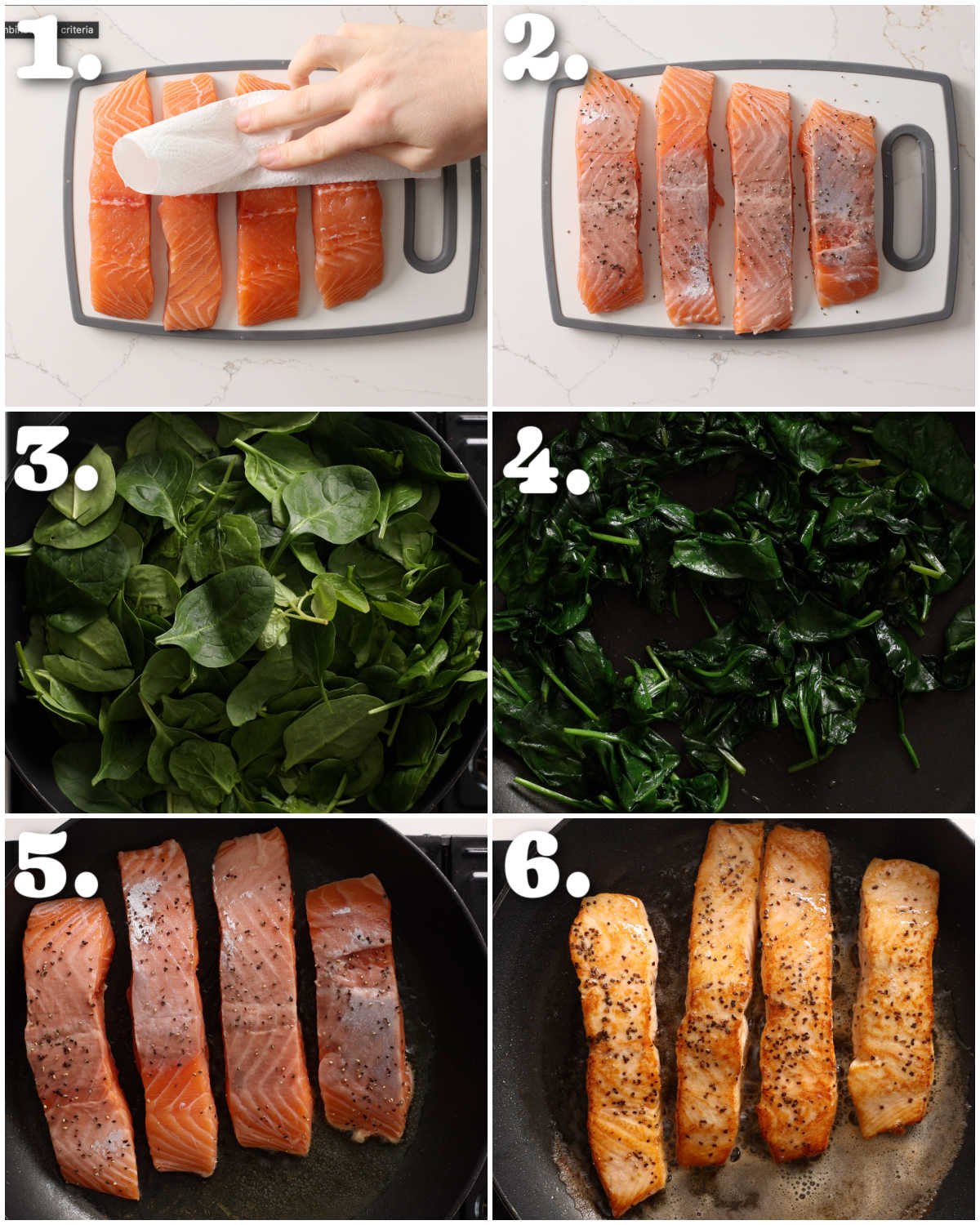
I actually like fry the spinach and remove it at the start of the recipe, as opposed to stirring it through at the end. This way, you can use paper towels to press and remove some of the water after it has fried. This is important, otherwise the spinach will release it into the sauce and risk making it watery.
Preparing the salmon
For this recipe we’ll be using skinless salmon fillets. You’ll want to start by patting them dry – this is important to remove moisture and prevent them steaming in the pan. In turn, this also helps the salmon caramelise and build up a golden crust. A generous pinch of salt and black pepper is all you need in terms of seasoning.
Cooking the salmon
We’ll be pan-frying salmon. Timings will differ depending on the thickness of the salmon, but here are a few general tips:
- Non-stick – ensure you’re using a non-stick pan. Salmon is very delicate and can stick/break quite easily.
- Butter – when you’ve got around a minute left of cooking, baste the fillets in butter to wrap them in a rich buttery flavour.
- Visual checks – the salmon should turn from deep pink to opaque, starting at the sides. It should still give slightly when pressed — if it feels firm, it’s overcooked.
Process shots: pat salmon dry (photo 1), season (photo 2), add spinach to pan (photo 3), fry then remove (photo 4), add salmon (photo 5), fry and baste then remove (photo 6).
Recipe Tip
If in doubt, pull the salmon off early. It will continue cooking slightly as it rests and when added back to the pan; it’s much easier to cook the salmon a little more than revive an overcooked fillet.
Florentine Sauce
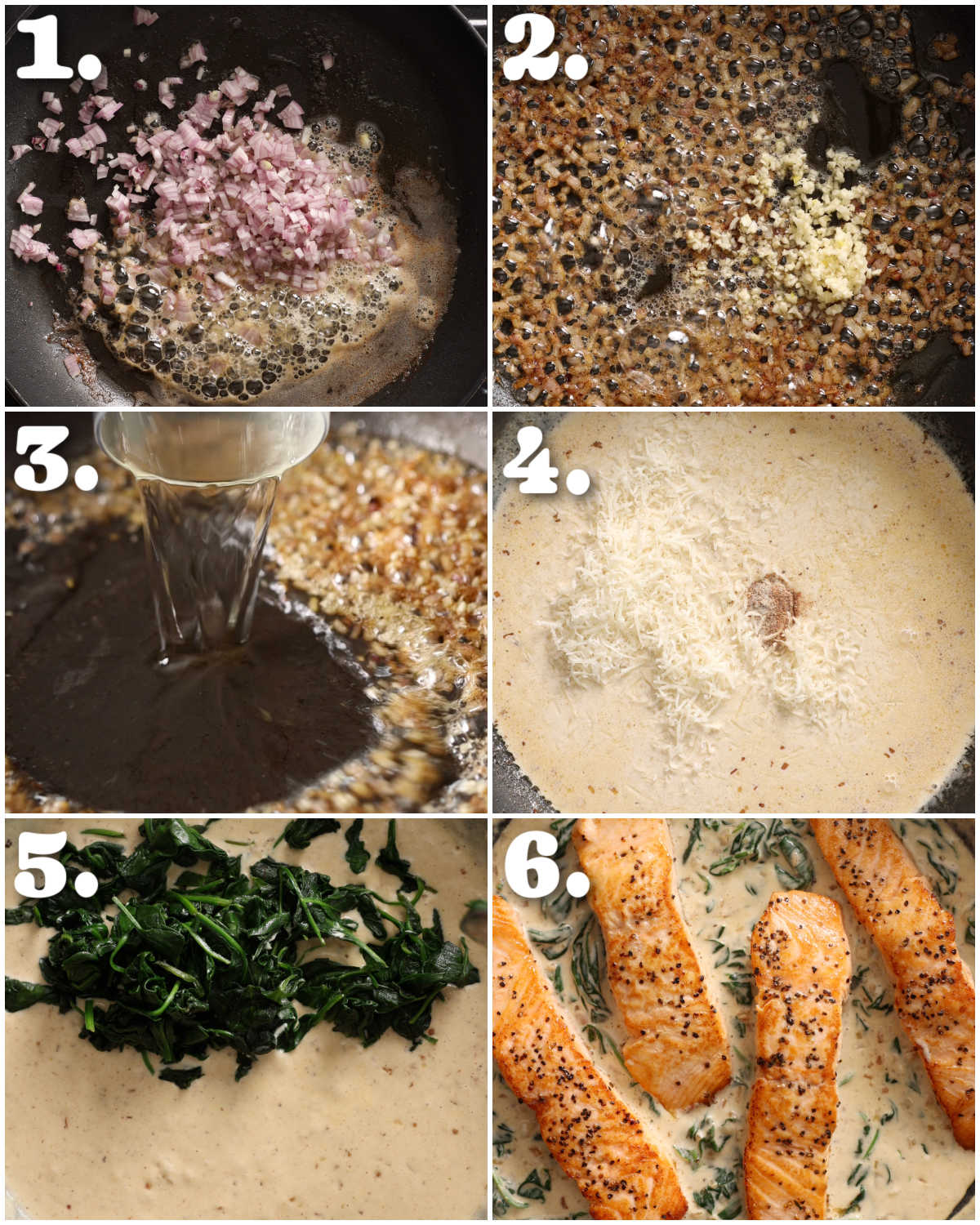
The sauce begins where the salmon leaves; in that gorgeous butter, which will now be nicely browned. From there, you can then gently fry the shallots and garlic to create a gorgeous flavour base for the sauce.
White wine
Alongside chicken stock and cream, we’ll also be adding a splash of white wine to create the sauce. This adds a lovely background flavour to the sauce and gives it that ‘restaurant-quality’ finish. It will also help cut through the rich, creamy sauce. If you can’t use alcohol, then just leave it out (the sauce will still be delicious).
Flavour boosters
To really take the sauce to new heights, I love adding some Parmesan, alongside some nutmeg and white pepper. The Parmesan adds a lovely depth of savoury flavour, whilst the nutmeg and pepper give the final ‘chef’s kiss’ and a nod to that classic bechamel flavour.
Process shots: fry shallots (photo 1), fry garlic (photo 2), reduce wine (photo 3), simmer stock, cream, parmesan and seasoning (photo 4), stir in spinach (photo 5), add salmon (photo 6).
How to serve Salmon Florentine
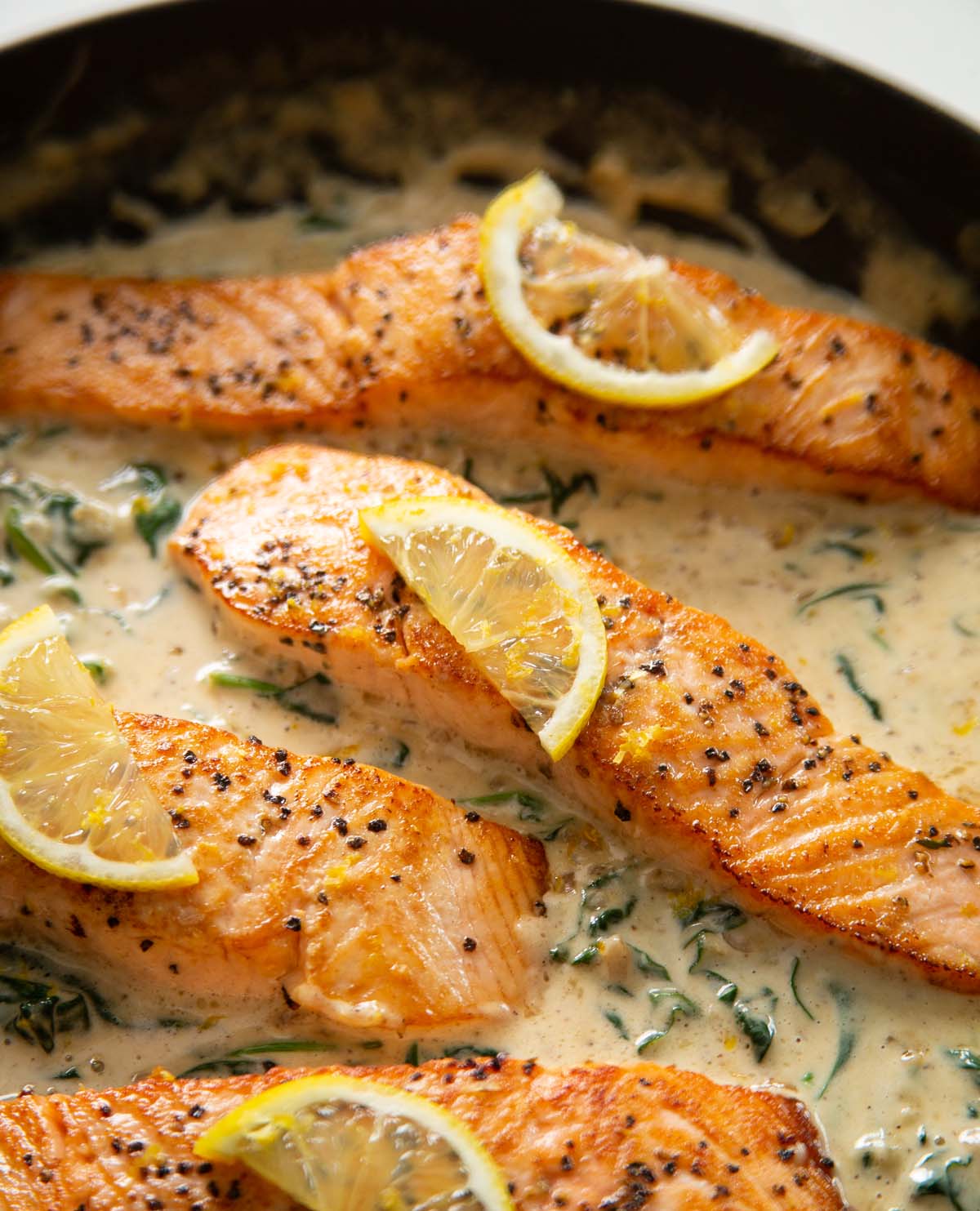
I like to add the salmon back to the sauce, just to warm it back through. I then like to go in with a light zesting of lemon. Not too much, just enough to brighten the dish at the end.
From there, you’ll want to serve with a lemon wedge to squeeze over when serving. I typically just add a carb on the side, since you’ve got a fair bit of spinach. Here are some ways I personally like to serve it:
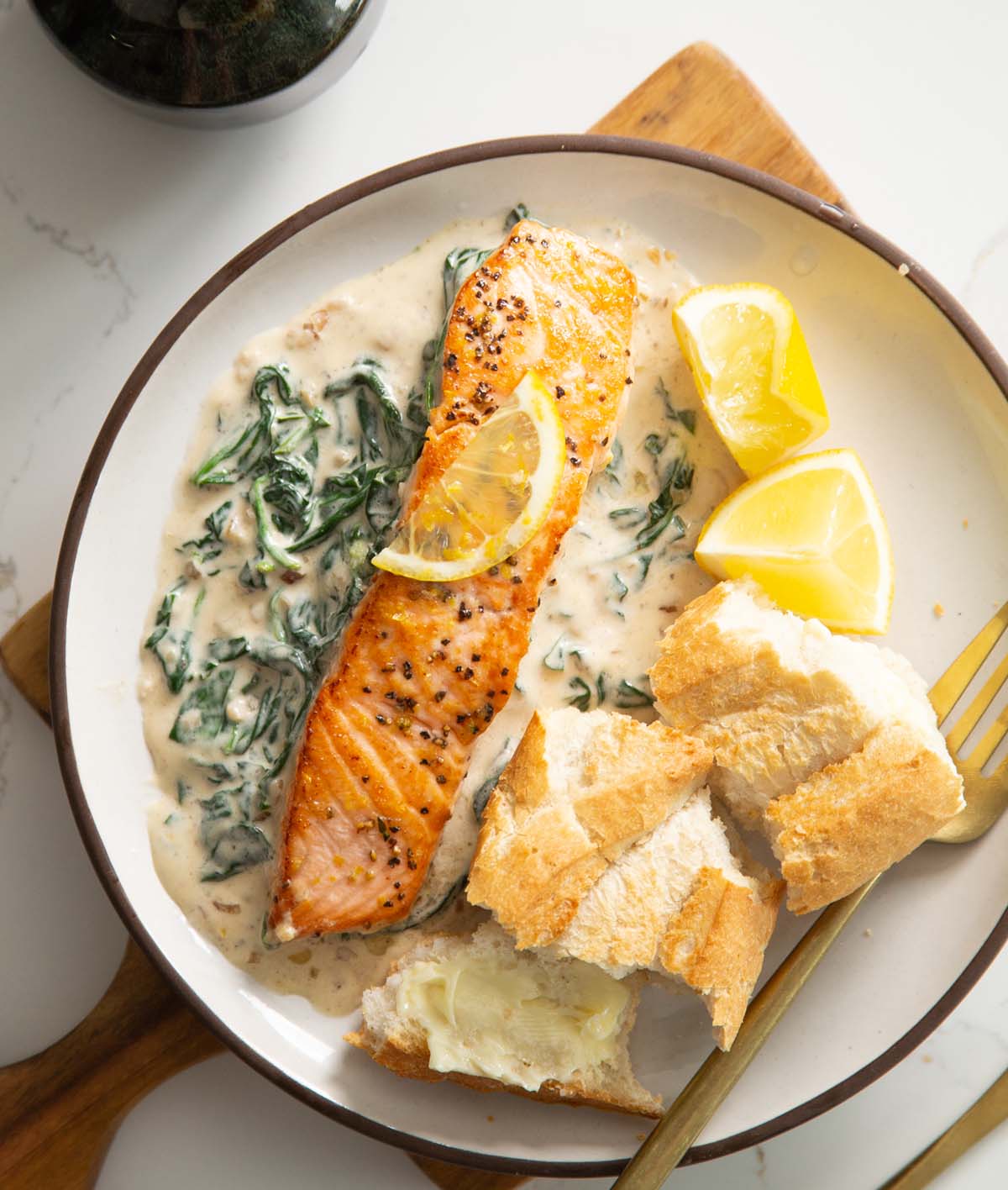
- Crusty bread – my favourite way (pictured below).
- Rice – gorgeous to soak in that sauce.
- Potatoes – any form of potato would work nicely here (roasted baby potatoes, mash or even duchess potatoes if you’re feeling fancy).
For another similar recipe, check out my Chicken and Creamed Spinach!
For more salmon fillet recipes, check out my Garlic Butter Salmon, Creamy Cajun Salmon and Creamy Lemon Salmon!
Alrighty, let’s tuck into the full recipe for this salmon florentine shall we?!
How to make Salmon Florentine (Full Recipe & Video)
-
Sharp Knife & Chopping Board
-
Paper Towels/Kitchen Roll (for patting salmon dry and drying spinach)
-
Large Non-Stick Pan & Tongs
-
Wooden Spoon
-
Jug (for stock/cream)
-
Microplane/Zester (for lemon)
Prevent your screen from going dark
-
Place a large non-stick pan over medium heat, then add a light drizzle of oil. Add the spinach and use your wooden spoon to press down, then begin stirring the spinach. Once the spinach has wilted, use tongs to remove it and place it on 2-3 linings of kitchen roll/paper towels. Place more on top and press down to squeeze out the excess moisture.
-
Use kitchen roll/paper towels to pat the salmon dry, then season both sides of the fillets with a good pinch of salt and black pepper.
-
Turn the heat to medium-high and add a drizzle of oil. Once hot, add the salmon presentation side down and fry for 3 minutes, or until golden and crisp on the bottom. Carefully flip and fry them for 2 minutes, then add the butter and baste them for 1 more minute, or until they’re just about cooked through and golden on both sides. Remove the salmon and place on a plate to one side, then lower the heat to medium.
-
Add the shallots to the leftover butter and fry until soft and golden, then add the garlic and fry for 30 seconds or so longer (be careful it doesn’t burn). Pour in the wine, increase the heat to a rapid simmer and cook for 3-4 minutes, or until it almost completely evaporates and the pungent smell of alcohol vanishes.
-
Lower the heat back down to medium and pour in the stock and cream. Stir in the parmesan, salt, white pepper and nutmeg until blended, then simmer for a few minutes until the sauce thickens. Stir in the resting juices from the salmon, then check for seasoning and adjust if needed. You can now stir in the spinach (the sauce might be quite thick, but the spinach will thin it out a little more).
-
I like to serve with a light zesting of lemon on top, then a lemon wedge per person to squeeze over at the end. You can also slice 2 thin rings from the lemon and halve them, to make 4 semi-circles to garnish the salmon.
b) Salmon – Cooking time will vary depending on the thickness of your salmon. Use your judgement — the sides should turn opaque, and the centre should flake easily with a fork.
c) Wine – This adds a lovely gentle background flavour. Make sure you reduce it to burn off the alcohol, otherwise the sauce will be sour. If you can’t use wine, just leave it out and be sure to finish with a good squeeze of lemon at the end.
d) Calories – Whole recipe divided by 4 assuming 1/2 tbsp olive oil and 500g/1/1lb salmon total.
Calories: 442kcal | Carbohydrates: 6.35g | Protein: 30.36g | Fat: 31.79g | Saturated Fat: 16.356g | Polyunsaturated Fat: 2.198g | Monounsaturated Fat: 9.732g | Trans Fat: 0.342g | Cholesterol: 141mg | Sodium: 472mg | Potassium: 771mg | Fiber: 1.2g | Sugar: 2.49g | Vitamin A: 4570IU | Vitamin C: 12.1mg | Calcium: 150mg | Iron: 1.76mg

PakarPBN
A Private Blog Network (PBN) is a collection of websites that are controlled by a single individual or organization and used primarily to build backlinks to a “money site” in order to influence its ranking in search engines such as Google. The core idea behind a PBN is based on the importance of backlinks in Google’s ranking algorithm. Since Google views backlinks as signals of authority and trust, some website owners attempt to artificially create these signals through a controlled network of sites.
In a typical PBN setup, the owner acquires expired or aged domains that already have existing authority, backlinks, and history. These domains are rebuilt with new content and hosted separately, often using different IP addresses, hosting providers, themes, and ownership details to make them appear unrelated. Within the content published on these sites, links are strategically placed that point to the main website the owner wants to rank higher. By doing this, the owner attempts to pass link equity (also known as “link juice”) from the PBN sites to the target website.
The purpose of a PBN is to give the impression that the target website is naturally earning links from multiple independent sources. If done effectively, this can temporarily improve keyword rankings, increase organic visibility, and drive more traffic from search results.