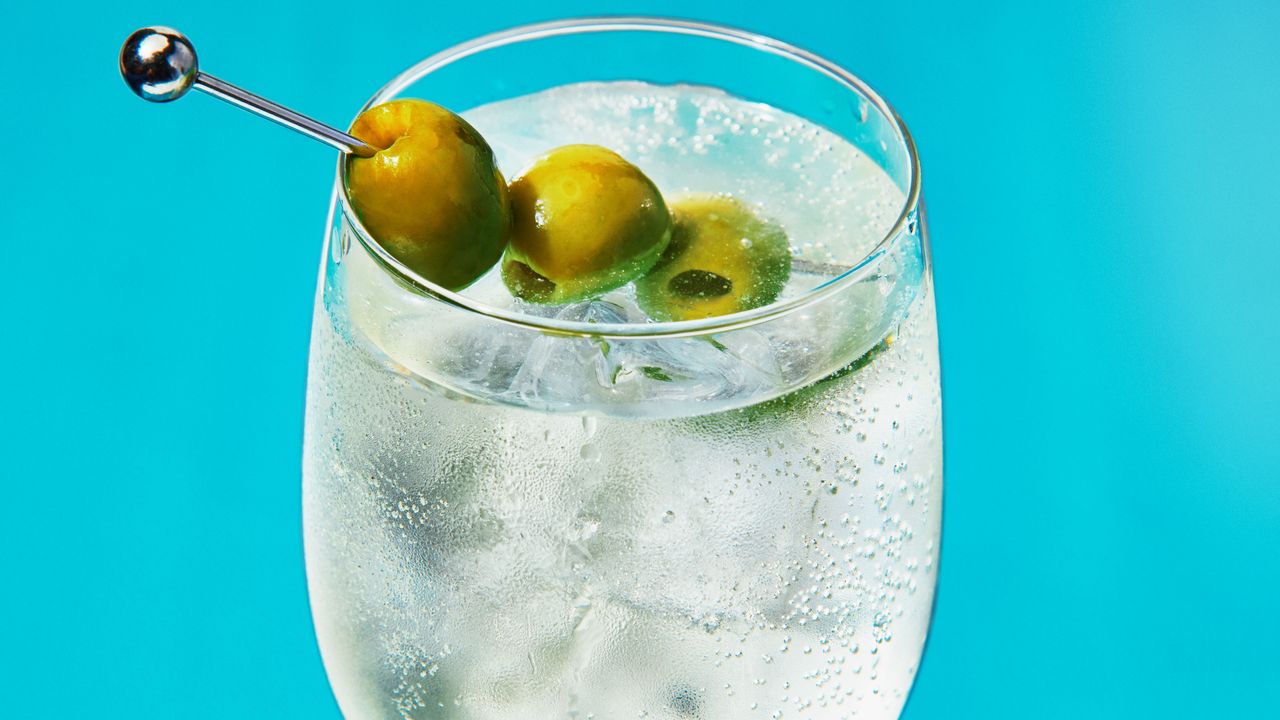
For martini drinkers craving bubbles and spritz fans seeking something drier, this is where the two meet. Built with vodka, dry vermouth, olive brine, and sparkling wine, the dirty martini spritz preserves the savory backbone of a dirty martini while opening it up with effervescence.
Brut Champagne gives the drink its backbone—its acidity stays crisp against the other players, keeping the drink focused and bright. Castelvetrano olives (my favorites are from New York institution Frankie’s 457) and their brine reinforce that structure, adding a clean salinity and subtle richness. The drink also has a one-two citrus punch: orange bitters (preferably Regan’s) tie together the briny and botanical notes of the olives and vermouth, while freshly expressed orange zest adds aromatic lift.
Tips for making a dirty martini spritz
Can I use Prosecco instead of Champagne?
Any brut sparkling wine will work, but the choice will shape the drink. Prosecco softens the profile, pushing it toward a more floral, fruit-forward spritz. Champagne, by contrast, keeps the drink tighter and more citrus-driven, reinforcing its martini structure. Cava—Spain’s answer to Champagne—is another strong option, bringing a slightly earthier, more savory edge. You don’t need an expensive bottle; something in the $15–$20 range will work well. For a deal, look for brut “Cremant,” produced using the same method as Champagne, but outside the designated region.
Why use both sparkling wine and club soda?
Sparkling wine provides flavor and structure, while club soda extends the drink without adding sweetness. Together, they create a quaffable, sessionable martini that remains crisp and totally refreshing.
Why Castelvetrano olives/brine? Can I adjust the amount?
Castelvetrano olives are milder and butterier than many grocery-store olives, making their brine bright and lively tasting rather than aggressively salty. That brine gives the drink its signature savory profile, but how much you use is easily adjusted.
For a lighter cocktail, reduce to ⅛ oz olive bring. For a more robust character, increase to ½ oz. (or more, this is your drink!). Want to skip the brine altogether? Add a pinch of salt for an even subtler effect.
The base can be mixed in advance, but carbonation should always be added just before serving.
For 8 servings, scale the base ingredients:
Stir together 1½ cups vodka, 1¼ cups dry vermouth, ¼ cup olive brine, and 10 dashes orange bitters (preferably Regan’s) and chill well.
To serve, fill a pitcher halfway with ice. Add 1½ cups chilled sparkling wine, followed by the chilled vodka mixture and 1½ cups club soda or seltzer. Stir gently just to combine.
Divide among 8 chilled wine glasses. Express a 3″-long strip orange zest over each drink and discard. Garnish each cocktail with 3 Castelvetrano olives (24 total) threaded onto a metal straw or cocktail pick.
What’s the best vodka for this? Can I swap in gin?
A clean, neutral vodka such as Ketel One or Reyka preserves the balance of the vermouth and olive brine. Gin can be used, though it shifts the drink toward a more traditional dry martini profile, with juniper and botanicals replacing vodka’s neutrality.
Play around: Try a nonalcoholic Dirty Spritz using citrusy booze-free amaro.
PakarPBN
A Private Blog Network (PBN) is a collection of websites that are controlled by a single individual or organization and used primarily to build backlinks to a “money site” in order to influence its ranking in search engines such as Google. The core idea behind a PBN is based on the importance of backlinks in Google’s ranking algorithm. Since Google views backlinks as signals of authority and trust, some website owners attempt to artificially create these signals through a controlled network of sites.
In a typical PBN setup, the owner acquires expired or aged domains that already have existing authority, backlinks, and history. These domains are rebuilt with new content and hosted separately, often using different IP addresses, hosting providers, themes, and ownership details to make them appear unrelated. Within the content published on these sites, links are strategically placed that point to the main website the owner wants to rank higher. By doing this, the owner attempts to pass link equity (also known as “link juice”) from the PBN sites to the target website.
The purpose of a PBN is to give the impression that the target website is naturally earning links from multiple independent sources. If done effectively, this can temporarily improve keyword rankings, increase organic visibility, and drive more traffic from search results.