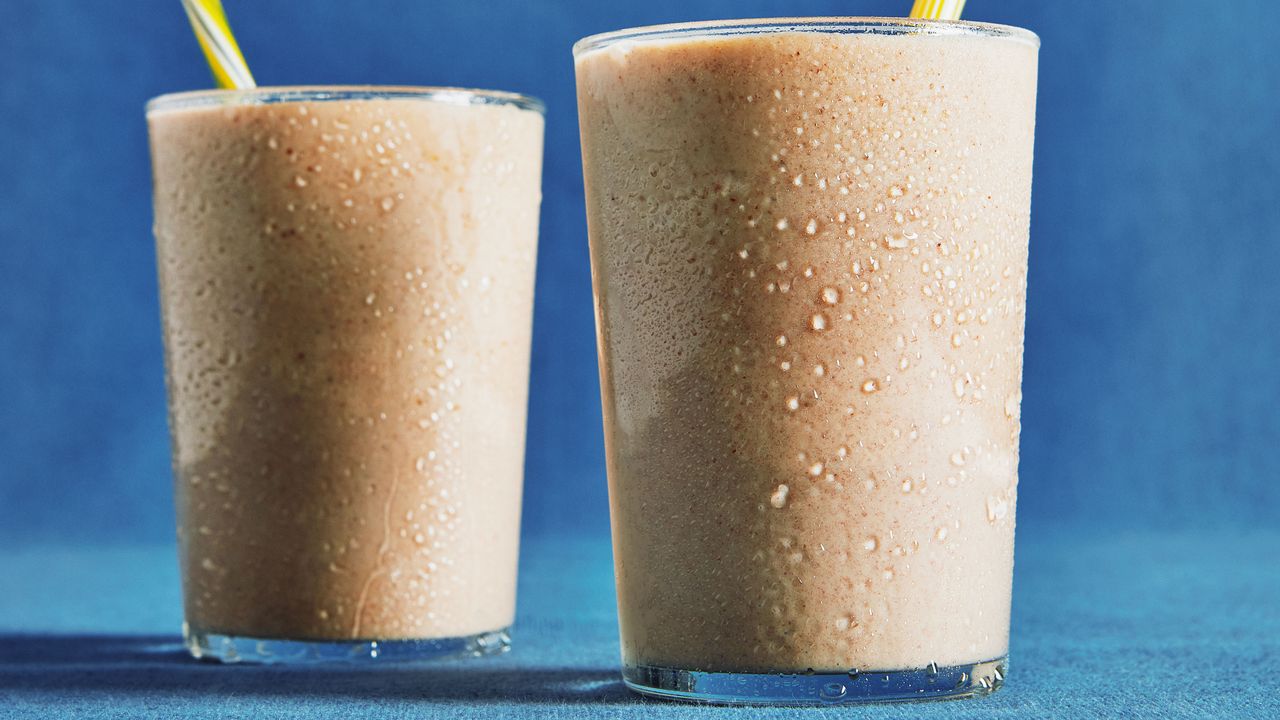
An old-school California date shake is definitely not a smoothie. A specialty of Southern California’s Coachella Valley, where date palms thrive in the desert climate, it’s a rich, sweet milkshake that’s spawned countless iterations made with frozen bananas, almond milk, Greek yogurt, or nut butter. This date shake recipe keeps the focus on the dates and store-bought vanilla ice cream.
Pitted Medjool dates give the shake its signature caramel-like sweetness and thick texture, while a pinch of cinnamon brings warmth. Our version also adds tahini for nutty flavor and an extra-silky texture. For the smoothest shake, soak the dates in hot water for 10 minutes before blending and give the ice cubes a few quick pulses to give them a head start.
Date Shake FAQ
Do I have to soak the dates?
Soaking the Medjool dates in hot water for 10 minutes softens them so they break down more easily in the blender. Save the soaking liquid: You’ll add a tablespoon to the shake, plus more as needed to help everything blend smoothly.
If you have a high-powered blender, like a Vitamix, you can get away without soaking, but the texture might not be as smooth.
Why do you crush the ice before making a date shake?
Pulsing the ice cubes a few times in the blender breaks them into smaller pieces before the other ingredients go in, helping them incorporate more easily. Don’t completely pulverize the ice at this stage; pulse just until lightly crushed.
Can you make a date shake without a high-speed blender?
Yes. A high-speed blender will give you the smoothest results, but soaking the dates and lightly crushing the ice before adding the remaining ingredients will help a standard blender process everything more easily.
What kind of dates should I use?
Use Medjool dates. They’re soft and plump, with a caramel-like sweetness that works especially well here. Here are our favorites:
PakarPBN
A Private Blog Network (PBN) is a collection of websites that are controlled by a single individual or organization and used primarily to build backlinks to a “money site” in order to influence its ranking in search engines such as Google. The core idea behind a PBN is based on the importance of backlinks in Google’s ranking algorithm. Since Google views backlinks as signals of authority and trust, some website owners attempt to artificially create these signals through a controlled network of sites.
In a typical PBN setup, the owner acquires expired or aged domains that already have existing authority, backlinks, and history. These domains are rebuilt with new content and hosted separately, often using different IP addresses, hosting providers, themes, and ownership details to make them appear unrelated. Within the content published on these sites, links are strategically placed that point to the main website the owner wants to rank higher. By doing this, the owner attempts to pass link equity (also known as “link juice”) from the PBN sites to the target website.
The purpose of a PBN is to give the impression that the target website is naturally earning links from multiple independent sources. If done effectively, this can temporarily improve keyword rankings, increase organic visibility, and drive more traffic from search results.