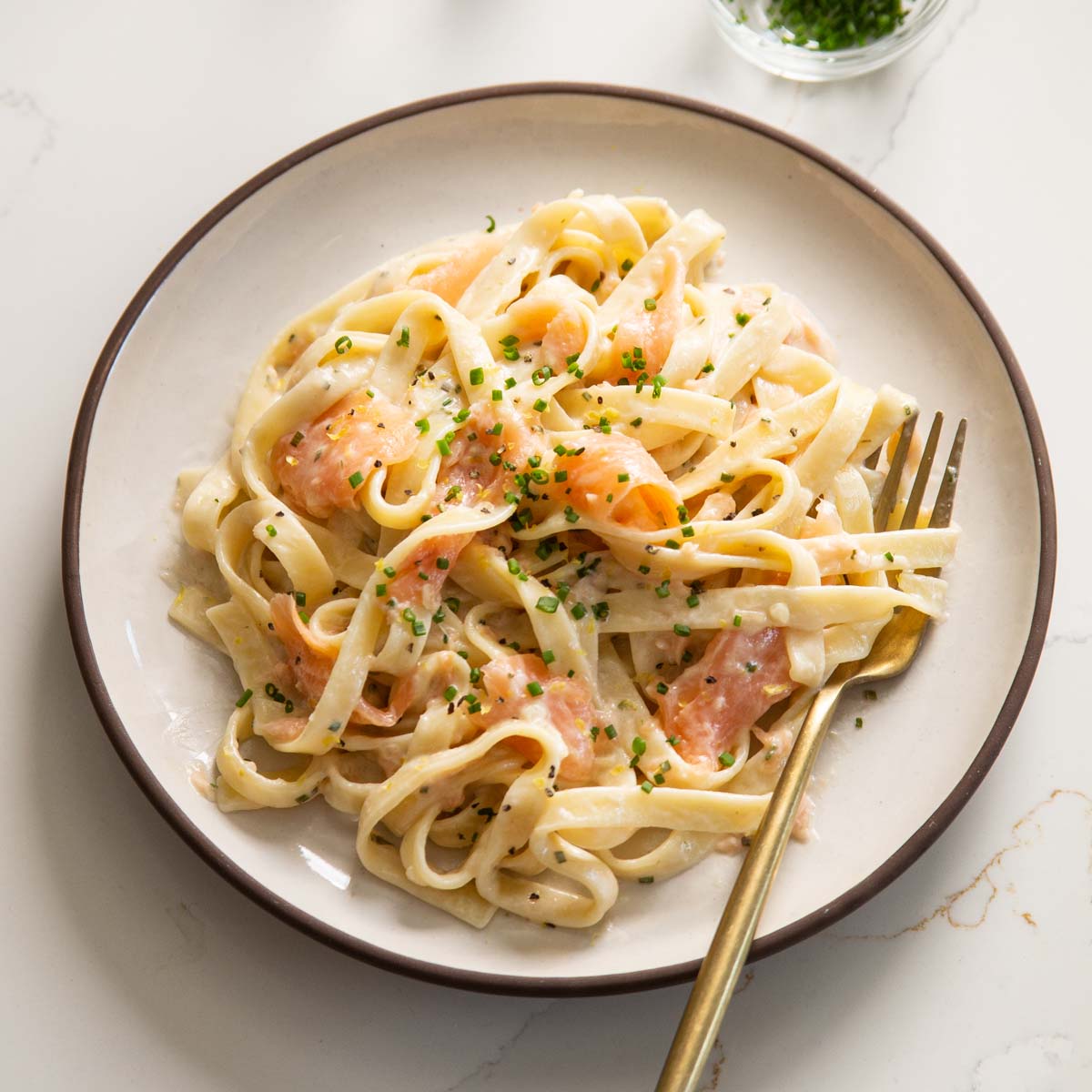
This creamy smoked salmon pasta is rich, silky and ridiculously easy to make. A quick, comforting dinner that tastes way fancier than it is.
And that’s what makes this specific recipe so special – it’s perfect for a quick and easy meal, but also ‘fancy’ enough for company or date night. All with minimal effort and simple ingredients. Follow me…
Pasta with Smoked Salmon
I really wanted to develop a sauce that classically partners with the salmon. As such, the base of the sauce actually uses cream cheese. Alongside some lemon and chives, this gives a nod to that classic flavour profile that is in a Smoked Salmon & Cream Cheese Bagel.
Flavour boosters
The base of the sauce is onion and shallots fried in butter. Because, quite frankly, that is the most delicious flavour base for so many creamy pasta sauces. Chicken stock is used for the base of the sauce to combine with the cream cheese. I also love a dash of Dijon mustard, which adds some complexity to the sauce (you don’t taste it, but it does a magnificent job in the background).
Smoked Salmon
The salmon is obviously very delicate, so you don’t want to add it to the pasta too soon and definitely don’t want to simmer it in the sauce. As such, I recommend making the sauce, tossing in the pasta, and only when you’ve got the perfect consistency should you gently toss through the smoked salmon.
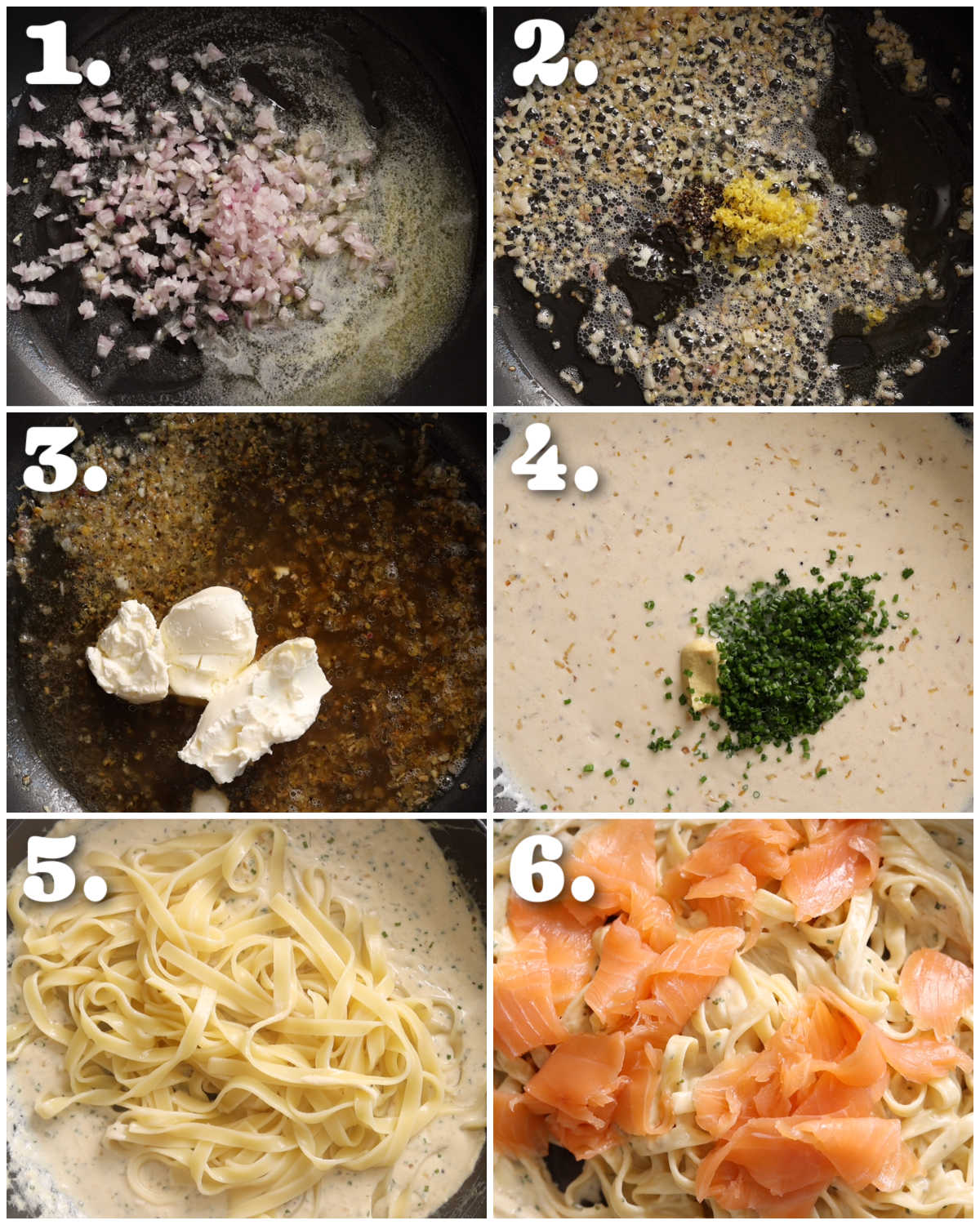
Process shots: fry shallots in butter (photo 1), fry pepper, garlic and lemon zest (photo 2), stir in stock and cream cheese (photo 3), stir in mustard, lemon juice and chives (photo 4), toss in pasta (photo 5), toss in salmon (photo 6).
Recipe Tip
When you add the pasta, I recommend using tongs to add it straight from the pot. This way, you can use the excess pasta water that comes with it to thin out the sauce. The starch will help emulsify the sauce too. You’re then left with a pot of pasta water to use if you need even more to thin out the sauce as you toss the pasta.
How to serve Smoked Salmon Pasta
The sauce will thicken pretty quickly, so just keep that in mind when you’re plating up. From there, I like a couple of garnishes:
- Chives – most of the chives are stirred through the pasta, but a pinch at the end adds a final pop of colour and flavour.
- Pepper – again, we’ve got a good amount of pepper through the pasta, but a little pinch at the end helps highlight what’s in the sauce.
For another similar recipe, check out my Creamy Dill Salmon Pasta, Spicy Salmon Pasta and Smoked Salmon Orzo Pasta Salad!
Alrighty, let’s tuck into the full recipe for this smoked salmon pasta recipe shall we?!
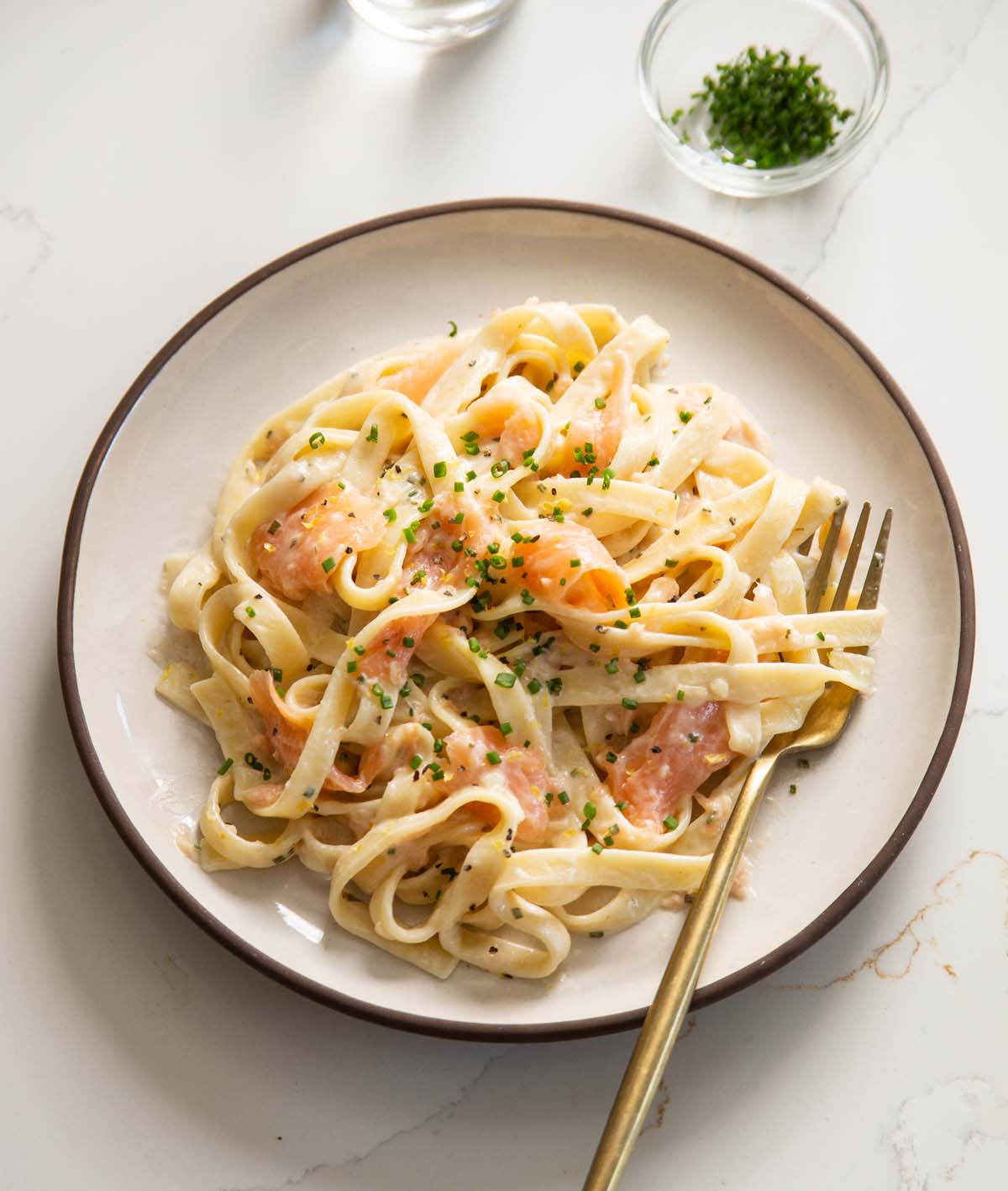
How to make Smoked Salmon Pasta (Full Recipe & Video)
-
Sharp Knife & Chopping Board
-
Large Pan & Wooden Spoon (for sauce)
-
Large Pot & Tongs (for cooking pasta)
-
Microplane/Zester (for lemon)
Prevent your screen from going dark
-
Add the pasta to salted boiling water and cook until al dente. Don’t drain.
-
Place a large pan over medium heat and melt the butter. Add the shallots and gently sweat them down until soft, golden and sweet. Add the pepper, garlic and zest of 1/2 a lemon and fry for 20 seconds or so (be careful it doesn’t burn).
-
Pour in the stock, then swiftly stir in the cream cheese until it blends into a sauce. Stir in 1 1/2 tbsp chives, 1 tsp lemon juice and 1/2 tsp Dijon, then bring to a gentle simmer. It should already be thick enough, but if it’s pretty watery, just gently simmer for a minute or so. Check for seasoning and adjust if needed (go easy on the salt as the salmon will add a good amount).
-
Cut the heat and use tongs to transfer the pasta straight from the pot into the pan. Toss until the sauce thickens and clings to the pasta. If you need to thin out the sauce, just simply toss in a splash of the leftover pasta water.
-
Once the sauce is the perfect consistency, gently toss in the smoked salmon until it’s just combined. Don’t go overboard, as it will be delicate.
-
Serve up with the leftover chives and some black pepper if desired, then tuck in and enjoy!
b) Cream Cheese – this will likely split a little when you stir it into the sauce, but give it a good whisk and it’ll come back together. Make sure you’re using full-fat cream cheese for the best flavour (it also has less risk of splitting).
c) Consistency – the sauce will thicken pretty quickly, especially once you add the pasta. Make sure it’s the perfect consistency before you add the salmon, just so you don’t have to toss the pasta too much and risk the salmon breaking up.
d) Salt – go easy when seasoning, as the smoked salmon just adds quite a bit of salt. Much easier to add more than take it out!
e) Calories – whole recipe divided by 2.
Calories: 706kcal | Carbohydrates: 85.14g | Protein: 24.31g | Fat: 31.19g | Saturated Fat: 17.216g | Polyunsaturated Fat: 3.003g | Monounsaturated Fat: 8.631g | Trans Fat: 0.481g | Cholesterol: 106mg | Sodium: 532mg | Potassium: 647mg | Fiber: 11.8g | Sugar: 3.73g | Vitamin A: 1281IU | Vitamin C: 4.8mg | Calcium: 66mg | Iron: 2.14mg
PakarPBN
A Private Blog Network (PBN) is a collection of websites that are controlled by a single individual or organization and used primarily to build backlinks to a “money site” in order to influence its ranking in search engines such as Google. The core idea behind a PBN is based on the importance of backlinks in Google’s ranking algorithm. Since Google views backlinks as signals of authority and trust, some website owners attempt to artificially create these signals through a controlled network of sites.
In a typical PBN setup, the owner acquires expired or aged domains that already have existing authority, backlinks, and history. These domains are rebuilt with new content and hosted separately, often using different IP addresses, hosting providers, themes, and ownership details to make them appear unrelated. Within the content published on these sites, links are strategically placed that point to the main website the owner wants to rank higher. By doing this, the owner attempts to pass link equity (also known as “link juice”) from the PBN sites to the target website.
The purpose of a PBN is to give the impression that the target website is naturally earning links from multiple independent sources. If done effectively, this can temporarily improve keyword rankings, increase organic visibility, and drive more traffic from search results.