
People don’t buy products. They buy what they see. Before they read your product description. Before they check your reviews. Also, before they compare prices.
They look at your image. And in less than a second, they decide:
- Is this brand trustworthy?
- Is this product high-quality?
- Is this worth my money?
That decision happens silently. Instantly. Emotionally. And image editing plays a massive role in it.
If you’re selling online — Amazon, Shopify, Etsy, your own website, image editing is not cosmetic. It’s strategic. It shapes how customers feel about your brand.
Let’s break down exactly how.
First Impressions Happen in Milliseconds
Studies show people form a visual impression in about 50 milliseconds.
That’s faster than a blink. In eCommerce, your product image is the handshake. It’s the storefront. It’s the salesperson. If your image looks:
- Dark
- Dull
- Crooked
- Color inaccurate
- Low resolution
Customers don’t consciously say, “This editing is poor.” They simply think, “This doesn’t feel premium.” And they leave. On the other hand, a bright, sharp, clean image instantly signals:
- Professionalism
- Care
- Quality
- Credibility
And that builds trust before a single word is read.
The Halo Effect: Why Good Images Make Products Look Better

The Halo Effect is a concept where one positive trait implies others. If your product image looks premium, customers assume it has other good qualities.
- The product itself is high quality
- The brand is established
- The service will be reliable
- The experience will be smooth
Now flip that. If your image looks amateur:
- They assume corners were cut
- They assume product quality may be lower
- They assume customer service may be weak
You might have an incredible product. But perception wins. Image editing directly influences that perception.
Lighting and Exposure: The Hidden Trust Builder
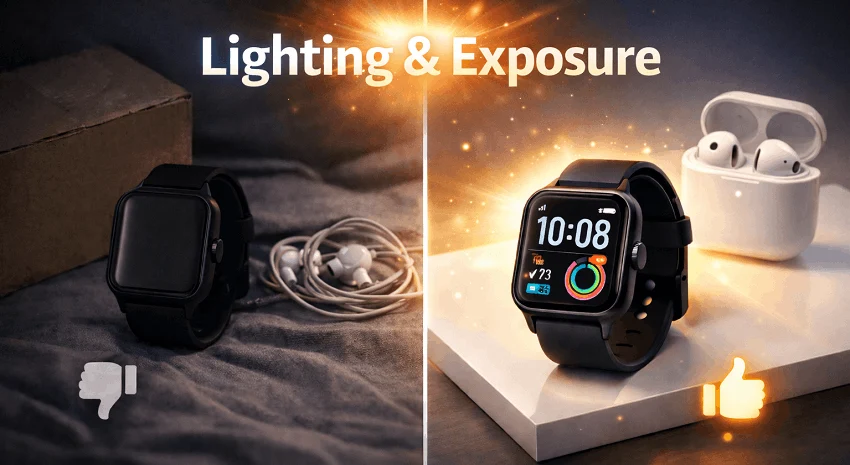
Let’s talk about something simple: brightness. Underexposed images feel:
Well-balanced lighting feels:
- Honest
- Transparent
- Professional
Proper exposure correction removes shadows that hide details. It makes textures visible. It clarifies edges. And clarity builds confidence.
In eCommerce, confidence reduces hesitation. Reduced hesitation increases conversions. It’s that simple.
Color Accuracy: The Conversion Multiplier
Color is emotional. Warm tones feel inviting. Cool tones feel premium. Muted tones feel minimal. High contrast feels bold.
But here’s the real issue: accuracy. If your product color is even slightly off:
- Returns increase
- Trust decreases
- Reviews suffer
Customers hate surprises. When editing ensures true-to-life colors, you reduce post-purchase regret. And that protects your brand long-term. For fashion brands, color consistency across catalog images creates a cohesive shopping experience.
For furniture brands, accurate wood tones affect perceived value. And, for cosmetics brands, color grading can literally determine whether someone clicks “Add to Cart.” Image editing controls all of that.
Background Removal and Clean Composition
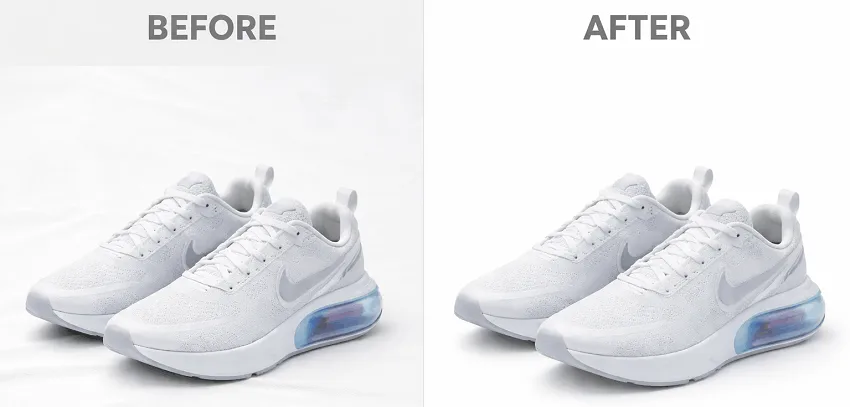
A messy background is a distraction. Distraction reduces clarity. Reduced clarity reduces confidence. Clean white backgrounds are powerful because they:
- Focus attention
- Standardize presentation
- Increase comparability
- Signal marketplace readiness
This is why marketplaces like Amazon require strict white backgrounds for main images. Clutter subconsciously says “unorganized.” Clean composition says “professional.”
Even subtle distractions like dust, uneven shadows, wrinkled backdrop, chip away at perceived quality. Editing removes friction. And friction kills sales.
Detail Enhancement: Making Products Feel Tangible
Online shopping has one big disadvantage. Customers cannot touch the product. So your image must simulate touch. Sharpness and clarity help customers imagine:
- Fabric texture
- Metal finish
- Surface smoothness
- Stitch quality
High-detail retouching makes products feel real. Low-detail images feel flat. When customers can visualize texture, they feel more certain about their purchase. Certainty increases conversion rates.
Image Editing and Brand Positioning
Your editing style defines your brand positioning. Luxury brands use:
Minimal brands use:
- Soft shadows
- Clean white space
- Balanced exposure
- Subtle tone correction
Fast fashion brands may focus on:
- Vibrant colors
- Dynamic cropping
- Trend-driven aesthetics
Editing isn’t just about correction. It’s communication. It tells customers where you sit in the market. Premium. Affordable. Bold. Minimal. Technical. Creative.
Your editing style must align with your pricing strategy. If you charge premium prices but use average images, customers feel the mismatch. And a mismatch reduces trust.
The Impact on Business Metrics
Let’s move from psychology to performance. Strong image editing directly impacts:
1. Conversion Rate
Clear, well-edited images remove doubt.
Less doubt = more purchases.
Even a small improvement in conversion rate can significantly increase revenue without increasing ad spend.
2. Bounce Rate
If your first image doesn’t impress, visitors leave. Better images increase engagement time.
Longer engagement increases purchase probability.
3. Ad Performance
On platforms like Meta and Google:
- Better visuals improve click-through rate
- Higher CTR lowers cost per click
- Lower CPC improves ROAS
Ad algorithms reward engagement. Editing impacts engagement.
4. Return Rate
When products look exactly as expected, returns decrease. Lower returns improve profitability.
And profit is what actually matters.
Marketplace Standards vs Website Expectations
Marketplace shoppers expect precision. Amazon requires:
- Pure white background
- Correct framing
- High resolution
- No distractions
If your images don’t meet standards, they feel “unofficial.” On your own website, you have more flexibility.
But consistency still matters. Inconsistent shadows. Different color tones. Mixed lighting styles.
All of that damages brand cohesion. Editing ensures uniformity across:
- Product pages
- Social media
- Ads
- Catalogs
Consistency builds brand memory. And brand memory builds repeat customers.
Common Editing Mistakes That Damage Perception
Editing helps. But over-editing hurts. Here are the biggest mistakes:
Over-Retouching
Plastic skin. Unreal textures. Artificial reflections. Customers notice. When products look fake, trust drops.
Unrealistic Shadows
Floating products look unnatural. Shadow inconsistency breaks realism.
Inconsistent Color Grading
If one product is warm-toned and another is cool-toned, your store feels chaotic.
Low-Resolution Exports
Blurry images scream “low quality.” High resolution signals investment. Editing should enhance reality, not distort it.
AI Editing vs Human Editing: Does It Matter?
AI editing tools are fast. Very fast.
They can remove backgrounds in seconds. Adjust exposure automatically. Batch processes thousands of images. For bulk catalog processing, AI is efficient.
But perception is nuanced. AI can sometimes:
- Miss fine edges
- Produce unnatural shadows
- Slightly distort colors
Human retouchers add:
- Judgment
- Brand sensitivity
- Detail precision
- Context awareness
In many cases, the strongest approach is hybrid. AI for speed. Human for refinement.
Because customers don’t care how you edit. They care how it looks.
A Real-World Scenario
Imagine two identical products. Same manufacturer. Same price.
Brand A uses:
- Flat lighting
- Slightly yellow tones
- Visible dust
- Inconsistent cropping
Brand B uses:
- Balanced lighting
- True-to-life color
- Clean background
- Uniform presentation
Which one feels more trustworthy? Most customers will choose Brand B.
Even if they can’t explain why. Perception drives action. And editing shapes perception.
How to Align Editing With Customer Expectations
Here’s what smart brands do:
1. Define Visual Standards
Create editing guidelines:
2. Match Editing to Audience
Luxury buyers expect polish. Budget buyers expect clarity. Different segments. Different editing strategies.
3. Maintain Consistency
Every product should look like it belongs in the same store. Consistency builds familiarity. Familiarity builds trust.
4. Test Variations
Run A/B tests:
- White vs light gray background
- Soft vs dramatic shadow
- Warm vs neutral tones
Let data guide decisions.
The Long-Term Impact on Brand Equity
Image editing does more than increase conversions. It builds brand equity. Over time, customers associate:
- Clean visuals with professionalism
- Accurate colors with honesty
- Sharp detail with craftsmanship
These associations compound. And compounding trust creates loyal customers. Loyal customers reduce acquisition costs. Which increases profitability.
The Bottom Line
Image editing is not about making pictures look “nice.” It’s about reducing doubt. It’s about increasing trust. It’s about aligning perception with product value.
Customers don’t see your editing process. They see the final image. And from that image, they decide:
- Is this worth my money?
- Is this brand reliable?
- Should I click buy?
Perception shapes reality in eCommerce. And image editing shapes perception. If you want higher conversions, stronger branding, better ad performance, and lower returns, start with your visuals.
Because in an online business, your image isn’t decoration. It’s a strategy.
Berita Terkini
Berita Terbaru
Daftar Terbaru
News
Berita Terbaru
Flash News
RuangJP
Pemilu
Berita Terkini
Prediksi Bola
Technology
Otomotif
Berita Terbaru
Teknologi
Berita terkini
Berita Pemilu
Berita Teknologi
Hiburan
master Slote
Berita Terkini
Pendidikan
Togel Deposit Pulsa
Daftar Judi Slot Online Terpercaya
Slot yang lagi gacor


